
Intent
We believe that Science permeates every aspect of our lives, from the technology we use on daily basis, to the natural world around us that sustains life on earth. Igniting children’s curiosity and passion to question and deepen their knowledge and understanding is central to our role as science leaders. We believe that through science, we can support the development of problem solving, critical thinking, evaluating and communicating that can be applied to the everyday challenges they face. We believe that fuelling a passion in Science will give children the tools they need to discuss and debate global issues that will impact their lives and prepare them for a changing future.
We believe that our lessons should be grounded in exploration and the progressive development of ideas, enabling children to build upon prior learning and develop a secure foundation of knowledge. We value practical experiences that are purposeful, challenging, and thought-provoking, encouraging children to reflect on their learning and consider their next steps. We also believe that science should be inclusive, providing opportunities for all children to participate, engage, and succeed.
Vocabulary
Children will develop the ability to apply subject specific vocabulary in science through consistent modelling by adults whilst establishing a culture of high expectations for discussions and debates. Here are some examples of the scientific vocabulary used:
Implementation
As a small school, our science curriculum is delivered as a rolling programme, with grouped units that deal with similar concepts together to enable complete coverage of all curriculum objectives. This ensures a spiral curriculum, where knowledge is gradually built upon in small steps. To support in the delivery of the Science Curriculum we use ‘Kapow Primary’ to plan and deliver our science units.
|
Year Group (Cycle A) |
|
|
|
|
|
|
|
Year 1 and 2 |
Y1 Animals including humans
‘Comparing animals’
|
Y2 Animals including humans
‘Senses’ |
Y2 Animals including humans
‘Life cycles and health’ |
Y1 Plants
‘Introduction to plants’ |
Y2 Plants
‘Plant growth’ |
Making connections
‘Ocean Protecters’ |
|
Year 3 and 4 |
Y3 Light
‘Energy: Light and shadow’ |
Y4 Electricity
‘Energy: electricity and circuits’ |
Y3 Materials
‘Rocks and soil’ |
Y4 Materials
‘States of matter’ |
Y3 Plants
‘Plant reproduction’ |
Making connections
‘Does hand span affect grip strength?’ |
|
Year 5 and 6 |
Y6 Light
‘Energy: light and reflection’ |
Y6 Electricity
‘Energy: circuits, batteries and switches’ |
Y5 Animals including humans
‘Animals: human timeline’ |
Y6 Animals including humans
‘Circulation and health’ |
Y6 Evolution and inheritance
‘Evolution and inheritance’ |
Making connections
‘Are some sunglasses safer than others?’ |
|
Year Group (Cycle B) |
|
|
|
|
|
|
|
Year 1 and 2 |
Y1 Everyday materials
‘Everyday materials, |
Y1 Seasonal changes
‘Seasonal changes’ |
Y2 Uses of Everyday materials
‘Uses of everyday materials’ |
Y2 Living Things and their habitats
‘Habitats’ |
Y2 Living Things and their habitats
‘Microhabitats’ |
Making connections
‘Fairytale Science’ |
|
Year 3 and 4 |
Y3 Forces
‘Forces and space: forces and magnets’ |
Y3 Animals including humans
‘Movement and nutrition’ |
Y4 Animals including humans
‘Digestion and food’ |
Y4 Living Things and their habitats
‘Classification and changing habitats’ |
Y4 Sound
‘Energy: sound and vibration’ |
Making connections
‘How does the flow of liquids compare?’ |
|
Year 5 and 6 |
Y5 Properties and changes of materials
‘Mixtures and separation’ |
Y5 Properties and changes of materials
‘Properties and changes’ |
Y5 Forces and space
‘Earth and space’ |
Y5 Forces and space
‘Unbalanced forces |
Y5 Animals including humans
‘Life cycles and reproduction’ |
Y6 Animals including humans
‘Living things: big and small’ |
This resource supports teachers in driving pupil progress and helps learners a develop secure understanding of each key block of knowledge in order to progress to the next stage.
We have three strands of focus that run through our science units, ensuring a comprehensive coverage of substantive and disciplinary knowledge. These are:
- Scientific knowledge and understanding
- Working scientifically
- Science in action
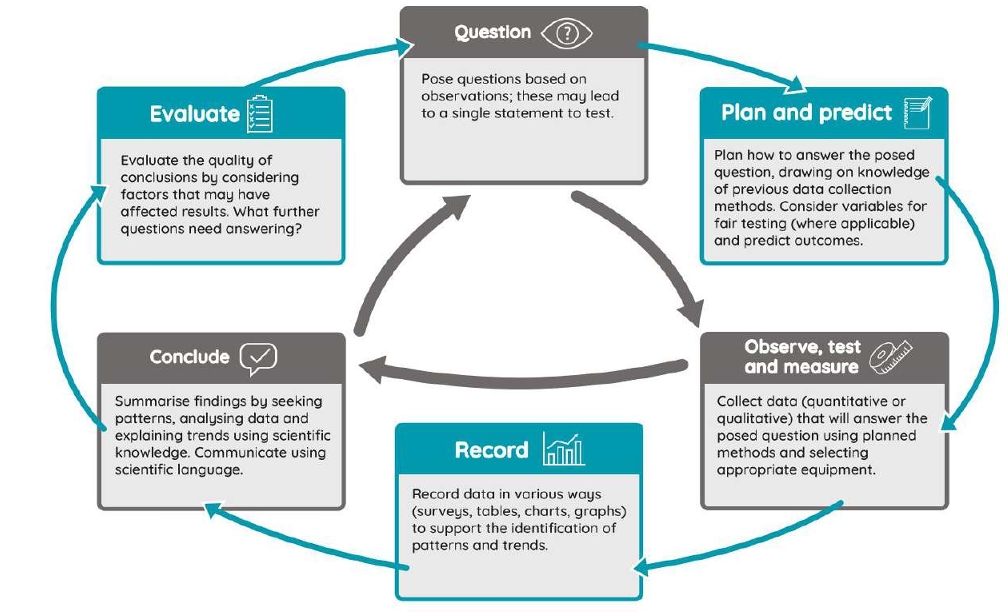
Moretonhampstead use a working scientifically enquiry cycle, with short enquiry opportunities that focus on a particular working scientifically skill, while ensuring the essential Question - Observe - Conclude cycle is met. There are also opportunities for skills to be taught in sequence so children can see how the skills work together.
Impact
Assessment at Moretonhampstead plays a vital role in supporting children’s learning and progress. It enables teachers to identify what pupils understand, where misconceptions may exist, and which next steps are needed to deepen understanding. We use a range of formative assessment (e.g. retrieval practise, questioning and discussions) during lessons and summative assessment for the end of units. ‘Knowledge catchers’ are used at the end of each unit to track children’s progress. Recap and recall sessions are implemented to help fill gaps when necessary.
Our aim is for science to nurture children’s curiosity and help them make sense of the world around them. It provides opportunities to explore, question, and investigate, developing key skills such as observation, prediction, and critical thinking.
Through practical and enquiry-based learning, children build a secure understanding of important scientific concepts while learning to work scientifically. This lays the foundation for future learning and helps develop confident, inquisitive learners who can apply their understanding across the wider curriculum and everyday life.