
Intent
|
We value languages as part of the children’s entitlement to a broad and balanced curriculum. We aim to encourage children to develop an appreciation of languages and foster their curiosity of the wider world. Languages underpin the connections, cultural capital and communication skills needed to be global citizens and open doors to further opportunities.
By learning a different language, we are supporting opportunities to develop further fluency and linguistic agility, building foundations for learning further languages, and thereby equipping pupils to travel, study and work in other countries. As a school, we use Twinkl planit to implement our Spanish lesson. |
Vocabulary
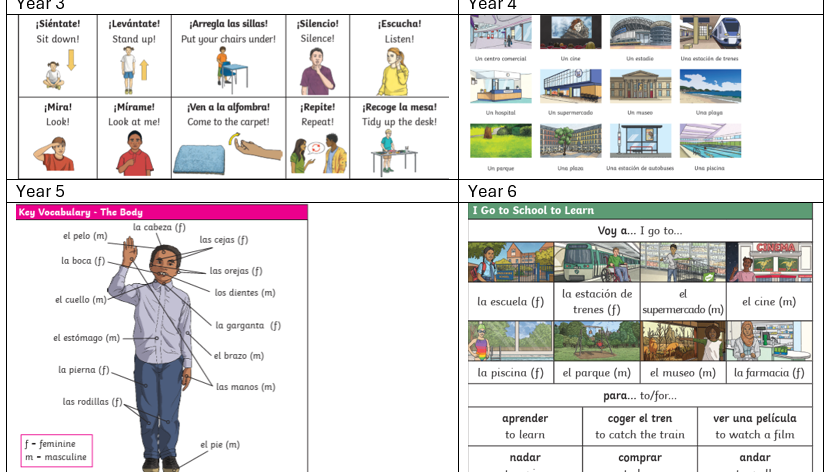
Children will develop the ability to apply subject specific vocabulary in Spanish through consistent modelling by adults, whilst establishing a culture of high expectations for discussions and debates. See below list of examples:
Rolling Programme
|
Year A |
Autumn 1 |
Autumn 2 |
Spring 1 |
Spring 2 |
Summer 1 |
Summer 2 |
|
Year 3 & 4 |
||||||
|
Year A |
Meet and Greet |
My Town |
Time to Eat |
Shopping |
All About School |
My Routine |
|
Year B |
My Body |
Let’s Go |
The People Around Me |
The Wider World |
Tell me When |
Free Time |
|
Year 5 & 6 |
||||||
|
Year A |
All About me |
Exploring a Spanish Town |
Eating Out |
Discovering Spain |
In the Classroom |
Our Wonderful World |
|
Year B |
The Way We Look |
At the Shops |
My World |
At what time? |
Our Past |
To the Next Adventure |
Impact
In Key Stage 2, pupils develop their skills in speaking, listening, reading and writing in Spanish. They build a secure foundation of vocabulary and begin to understand basic grammar. Pupils develop confidence in pronunciation and are able to take part in simple conversations, ask and answer questions, and express ideas.
Pupils build on prior learning over time and use subject-specific vocabulary with increasing accuracy. They demonstrate growing confidence and enjoyment in language learning, supported by regular practice and revisiting of key knowledge.
Children develop an awareness of other cultures and begin to understand the value of learning a language in the wider world. They recognise how languages support communication beyond their immediate environment.
By the end of Key Stage 2, pupils have the knowledge and foundations needed to continue language learning at Key Stage 3 and understand how this can support future opportunities.